NSLC Business & Entrepreneurship · University of Michigan
The Engine
Completing Your Plan
Lecture 3 · Danny Ellis
Before we talk about your money… let me tell you about ours
SkySpecs effectively ran out of money four times.
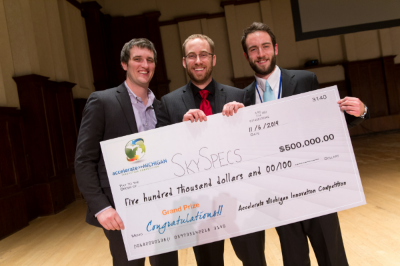
The first time: we'd raised $600,000 and spent every dollar of it on R&D in a single year. We were two weeks from missing payroll — and happened to win a $500,000 business competition that same month. Lucky timing. Never bank on business competitions to fund your business.
But that wasn't the scary one. The scary one came when we still had cash in the bank and had just landed the largest contract in company history…
…and we were losing money on the overall deal — our biggest win, quietly draining our cash position before the next fundraise.
How does your biggest contract almost sink the company? That's exactly the math we're doing today… →
Today's roadmap
You have an idea and an edge. Now we prove it makes money.
1 · One Unit
What exactly are you selling?
2 · Expenses
Startup, fixed, and variable costs
3 · Unit Economics
COGS & contribution margin
4 · Break-Even
How many sales until you survive?
5 · Funding
Where the starting money comes from
Why this matters at the pitch: the rubric line judges poke hardest is Cost Structure — “price is profitable and competitive; feasible break-even plan.” Today is that slide.
Block 1 · One Unit
Profitability starts with a microscope, not a telescope
Forget the whole company for a second. Ask: do I make money on ONE single sale?
A unit of sale is what a customer actually buys from you — one item, one bundle, one hour, one month.
For a service business, the unit is based on how the customer is charged — per hour, per session, per month.
The logic
If one unit loses money, a million units lose a million times more. “We'll make it up in volume” is how businesses die with a straight face.
One Unit · Case study
Same company, three units — SkySpecs tried them all
Per drone
The hardware lens: sell the machine, one drone = one unit. Simple — until we learned the customer had nobody in the field to fly it.
Per turbine
The service lens: one turbine inspected = one unit, one fee. The unit customers actually understood — and the one we first scaled on.
Per megawatt
The portfolio lens: price scales with the size of the fleet we look after. One number that grows as the customer grows.
Same business, three lenses — and we evolved through all three. The unit you pick decides what you optimize: hardware margins, per-job efficiency, or long-term fleet value.
You choose the unit — then every number in your plan speaks that language.
Block 2 · Expenses
Startup expenses: the price of opening the doors
One-time costs to get the business running — think minimum to get off the ground, not a wish list.
Large equipment
Reusable gear: ovens, machines, vehicles
Licenses
Business licenses & permits
Furniture & office
Desks, chairs, office equipment
Initial materials
Your first batch of inventory
Technology
Hardware & software to operate
Website build
Getting your storefront online
Initial marketing
The launch push that announces you exist
The rule
Every dollar here delays break-even. Cut ruthlessly.
Startup expenses · Case study
Every first budget is wrong. Ours certainly were.
The $300 ladder we refused to buy.
- Every first budget misses the same things: everything beyond salaries, software, and rent — and the fully loaded cost of an employee (insurance, payroll tax, benefits) is far more than the salary
- Dozens of small costs quietly add up to huge numbers. We missed those forecasts constantly
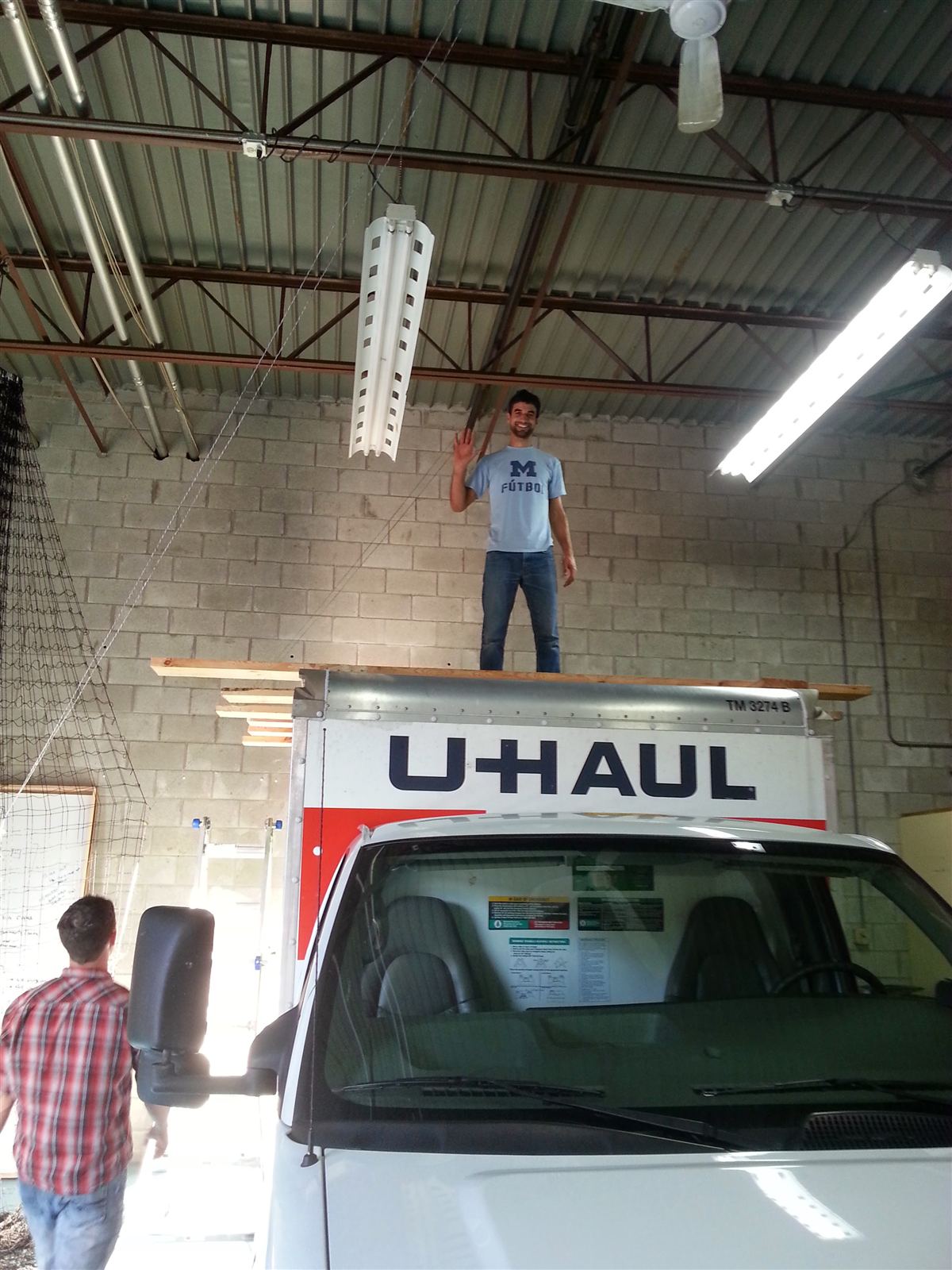
- Our first office: a tiny empty warehouse behind the Ann Arbor Airport. To test the drone we had to hang a net from the 20-ft ceiling — and the ladder to reach it cost $300
- No investor dollars yet — we were living on competition wins and grants. $300 for a one-time climb? No. We got creative →
Block 2 · Expenses
After launch, every expense is one of two kinds
Fixed expenses
Paid regularly even if you sell nothing. Insurance, salaries, advertising, interest, utilities, rent, website hosting.
You pay fixed costs no matter what. They're the treadmill that never stops.
Variable expenses
Change with how much you sell. Materials, ingredients, labor per order, shipping, logistics, packaging.
Sell more, spend more. Sell nothing, spend nothing.
Why split them? Because fixed costs set your break-even and variable costs set your margin. Two different diseases, two different cures.
At SkySpecs: the engineering team's payroll arrived whether we flew that month or not — fixed. The labor to deliver each inspection job scaled with every contract we signed — variable.
Block 3 · Unit Economics
What does ONE unit cost to make?
COGS — Cost of Goods Sold
The total expenses of making each unit of a product: the materials in it + the labor to make it.
COSS — Cost of Services Sold
The same idea for services: what it costs you to deliver one unit of the service.
Always stated per unit. Not “we spend this much on materials a month” — but “each unit carries this much material and this much labor.”
Block 3 · Unit Economics
Contribution margin: what each sale contributes
The amount from each unit that goes toward paying fixed costs — and then becoming profit.
The higher the contribution margin, the higher your final profit. Every dollar of margin is a dollar working for you instead of leaving with the sale.
Negative margin alarm
If price < COGS, every sale digs the hole deeper. Congratulations — you've built a machine that converts effort into losses.
Deeper dive · Unit Economics
🎚️ Three levers to fatten your margin
Raise the price
The fastest lever — but only if your value proposition (Lecture 2) earns it. Price is a claim about value.
Cut materials cost
Cheaper suppliers, bulk buying, less waste. Careful: cut quality and the customer notices before your spreadsheet does.
Cut labor per unit
Faster process, better tools, batching. This is where technology quietly wins — the same person makes more units per hour.
Our drones cost $40,000 apiece. We charged $350 a turbine. You do the math.
- Add the insane R&D capital, the labor to deliver every job, the infrastructure to host the inspections — it was going to take tens of thousands of turbines for that math to ever work
- The unlock: the drone wasn't the product. The data — and the action items that came from it — were worth far more than the flight
- Once we saw that, the goal flipped: just break even on the cost of capturing the data, and let the data carry the margin
Block 4 · Break-Even
The monthly break-even point
The month you sell exactly enough units to cover your monthly expenses. Not winning yet — but officially not losing.
Revenue < Expenses
Loss. The engine burns more fuel than it makes. Every business starts here.
Revenue = Expenses
Break-even. The engine pays for itself. This is the survival line.
Revenue > Expenses
Profit. Every extra unit's margin is now pure gain.
Break-Even · The centerpiece
The break-even simulator — find your survival line
units/month to break even
Where the green line crosses the red line, you stop bleeding. 🟢 revenue · 🔴 total costs · 🟡 break-even
Block 5 · Funding
Five ways to fund a startup — each arrow press flips one
The real question
Not “which sounds coolest” — which matches your speed, risk, and control needs.
Deeper dive · Funding
🏛️ The SBA alphabet, decoded
SBIC
Small Business Investment Company — private investment funds licensed by the SBA that invest in small businesses, with government-backed leverage behind them.
SBIR
Small Business Innovation Research — competitive federal grants that fund small companies doing R&D with commercial potential. Money you don't repay and don't give equity for.
STTR
Small Business Technology Transfer — like SBIR, but you partner with a research institution (like, say, a certain university in Ann Arbor).
Over $1M in grants, competitions, and in-kind services launched SkySpecs.
- That's non-dilutive funding — money that doesn't cost you a piece of your company. Now you know why founders love the phrase
- Scale check: we went on to raise over $140M in equity, so grants never balanced the equation — but they were the launchpad we needed
- The good news for you: with today's tools, the same company could be built with far less venture capital
Funding · From someone who's done it
What raising venture capital is actually like
I pitched over 1,000 times in 13 years. I've been told no more times than I can count.
- You have to get comfortable hearing no — over and over and over. Each no is a rep: learn, tweak, adapt, adjust
- The nos are how you find the right partners with the right capital for your idea — not just any check
- It will feel daunting. It will be emotional. Some days it's flat-out depressing. Then you find the fit — and the real challenge starts: putting that capital to work correctly
Your mission · Breakout 6
Build your financial plan — the checklist
Workbook p. 21+. Leave the breakout with all six boxes checked:
- ✅ Define your one unit — what exactly does one customer buy, at what price?
- ✅ List your startup expenses — the minimum one-time costs to open the doors
- ✅ Categorize every monthly expense — fixed or variable, using the zero-sales test
- ✅ Compute your contribution margin — selling price − COGS, per unit
- ✅ Compute your monthly break-even — fixed expenses ÷ contribution margin
- ✅ Pick your funding plan — which of the five methods, and why it fits your speed, risk, and control
The bar: when a judge asks “does this actually make money?”, your team answers with a number, not a vibe.
Three lectures · One pitch
Problem → Edge → Engine. You now have all ten slides.
1 · Title
Who you are, in one clean slide — nail it at the pitch
2 · Problem / Opportunity
Lecture 1 — the pain you solve
3 · Value Proposition
Lecture 2 — why customers pick you
4 · Underlying Magic
Lecture 2 — the edge nobody copies easily
5 · Target Market
Lecture 2 — who buys first
6 · Competitive Analysis
Lecture 2 — the playing field, mapped
7 · Marketing Plan
Lecture 2 — how they find you
8 · Cost Structure
Today — units, margins, break-even
9 · Status & Future Plans
Today — funding plan + where the engine goes next
10 · Ending
Your hook, closed — Lecture 1's storytelling, full circle
🟡 Lecture 1 · 🔵 Lecture 2 · 🟢 Today. The curriculum was the pitch all along.
One thing to remember
Revenue is oxygen. Profit is the pulse.
A business that breathes but has no heartbeat is just an expensive hobby.
So how did the biggest-contract-that-lost-money resolve? With today's exact math.
- The lever that saved us was margin — facing the unit economics of a $40,000 drone charging $350 a turbine, and repricing around what the data was actually worth
- A profitable idea will beat an unprofitable one, every time. You can raise money to bridge the gap for a while — but the unit economics have to work eventually, and you have to keep building momentum toward them
- Once the units worked, scale stopped punishing us and started paying us
- Your numbers are smaller, but the math is identical. Go run your engine.